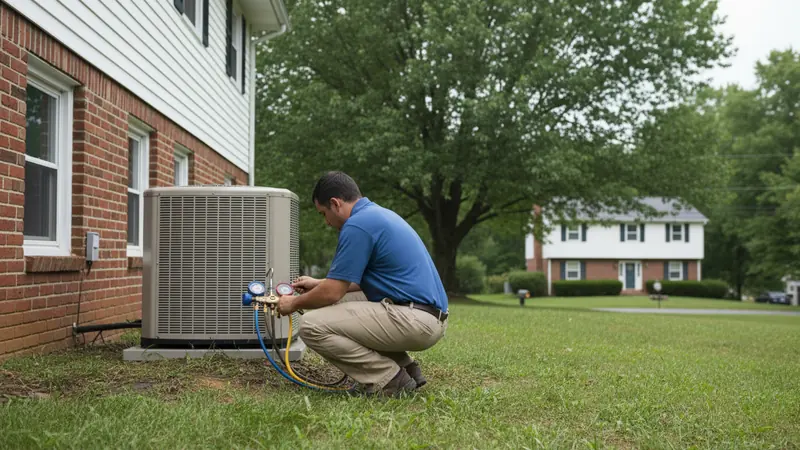
What you need to know about permits, inspections and published fees before replacing heating or cooling equipment in Loudoun County. What to check in your house, too.
Each figure comes with the date we gathered it. We distinguish published fees from estimated review times and measured results.
Do you actually need a permit?
Replacing electric equipment has different permit rules from replacing a gas furnace. Virginia exempts some mechanical appliance replacements in residential occupancy groups R-3, R-4 and R-5. The exemption also covers R-2 when serving a single-family dwelling. It only applies to appliances that are not gas- or oil-fired. A straightforward residential electric heat-pump replacement can qualify. A gas or oil furnace replacement cannot.
You generally need permits to install or alter mechanical, electrical or fuel-supply systems. Check extra circuits, changed gas piping or added ducts separately. An equipment exemption does not exempt the whole job. Exempt work must still meet code. The building official may also require a permit for otherwise exempt work in a special flood hazard area.
For an emergency replacement, you must apply by the end of the first working day after work begins. That is the state’s application deadline. You still have to apply.
Why the fee schedule alone cannot answer this. Loudoun lists fees for replacement equipment without repeating every exemption. We use the state exemption for qualifying electric replacements. Confirm mixed systems or expanded work with Building and Development at 703-777-0220, option 1.
Loudoun lists electrical, gas, mechanical and plumbing permits separately. If your job has a parent building permit, trade applications go in as separate sub-records. Approval of the architectural plans does not automatically issue those permits. The mechanical application distinguishes heat pumps, furnaces or boilers, air conditioners and duct-only work. A quote saying only “HVAC permit included” leaves you unsure what it covers.
Source: Virginia DHCD, 13VAC5-63-80, Section 108, particularly 108.1 and 108.2(14.4), last amended effective 2024-01-18; Loudoun County Building and Development, Residential and Commercial Construction Permits and Building Inspections, undated; Mechanical Permit Application, revised 2017-07-13. Gathered 2026-09-22.
What the permit costs
The county’s fee page still links its schedule effective July 1, 2022. These are published trade charges. They do not give you a universal total for replacing a system.
| Permit or fee item | Published charge |
|---|---|
| Mechanical: central heating or air conditioning, one- and two-family dwellings | $70 |
| Gas equipment, one- and two-family dwellings | $70 |
| Propane service: tank and piping, one- and two-family dwellings | $70 |
| Electrical: electric heating and air conditioning | $25 each |
| Electrical: residential fixtures, receptacles and circuits | $70 |
| Mechanical: motor-fuel or fuel-oil tanks and associated piping | $155 |
| Additional trade reinspection | $30 each |
The mechanical, gas and electrical schedules include two inspections. That allowance does not tell you which inspection stages your work needs.
No blanket changeout total. The schedule does not explain every combination of mechanical, gas and electrical charges for a replacement. The electrical equipment row says “each”. The residential mechanical row does not say “per zone.” We use the published rows. We cannot turn them into a charge per zone or an all-in bill. The county can confirm which charges apply at 703-777-0220.
The county bills you when it takes in your application. Review cannot start until you pay. Online card payments carry a 2.65% convenience fee. You can also pay by cash or cheque. The payment fee is separate from the trade charges above. Your contractor may charge for preparing and managing the permit too. Ask for an itemised quote that separates that charge from the government’s fee.
Source: Loudoun County Building and Development, Application Fee Schedule, trade fees on pages 10–12, effective 2022-07-01; Fee Schedules and Payment Options, undated current payment instructions. Gathered 2026-09-22.
Gas work: the plan-review change that affects a replacement quote
From October 1, 2025, residential gas applications for new construction, alterations, additions and pools require plans. Replacements are excluded from that review if they stay in place without increased BTU input. A review exemption is not a permit exemption.
| Residential gas application requiring review | County's stated fee |
|---|---|
| New construction | $65, with no base gas permit fee |
| Alteration or addition | $135: $70 base plus $65 review |
These amounts cover the gas permit described in the notice. They do not cover every permit for your HVAC job.
Awkward wording in the notice. It says replacements must not “increase the BTUs or the physical location.” We read that as no increase in input. We also read it as no relocation. Plans Review can confirm at 571-627-8111 or 571-627-8132.
The drawing requirements explain why a larger furnace means more than changing a model number. For a manifold system, show the supply pressure. Give the pipe lengths, materials and sizes. Include input ratings for existing and proposed appliances. Without a manifold, you still need to show gas loads and branch sizes across the system. Include the relevant pipe lengths and supply pressure too.
For an outside propane installation, show the tank size. Say whether it is buried. Give the line material and size. Include the gas load and regulator pressures. A drawing of only the replacement furnace misses information the county asks for. If your estimate includes moving equipment, include that in the permit scope from the start. The same applies to adding another gas appliance.
Source: Loudoun County Building and Development, Plans Review to be Required for Some Residential Fuel Gas Permits, posted and effective 2025-10-01; Plans Submittal Criteria for Residential Gas Permits, undated supporting instructions. Gathered 2026-09-22.
How long the permit actually takes
Loudoun publishes expected processing times. These are targets, not measured turnaround statistics. We could not verify a county-specific median for HVAC replacements.
Residential trade applications have a published intake window of two to five business days after application. At intake, the county checks that your application is complete. Review follows intake and payment. The dashboard’s general trade review row says two days.
The gas notice instead allows approximately ten days after intake for new-construction, alteration and addition gas plans.
Two published timelines, different scopes. We use the gas-specific estimate for jobs needing that review. Neither review estimate says whether it means calendar or business days. Intake explicitly says business days. We cannot add these times into a promised completion date. Use the residential dashboard's permit-status inquiry to check your application.
The county’s February 10, 2026 delay notice reported six to eight weeks for specified building permits requiring zoning review. It said trade timelines remained standard. Do not assume that delay applies to a standalone mechanical replacement. An addition that includes HVAC may depend on different approvals from a job replacing existing equipment.
Check which stage your application has reached. It may be waiting for intake. It may be paid and under review. The permit may already be issued. Your contractor’s installation date is separate. The later inspection appointment is another date again.
Source: Loudoun County Building and Development, Residential Permits Processing Dashboard, undated live guidance; residential gas review notice, effective 2025-10-01; Permits Requiring Zoning Review Experiencing Extended Review Times, published 2026-02-10. Gathered 2026-09-22.
The inspections
Use LandMARC to request your inspection. Check the result there too. You can request the following workday or a later date, excluding weekends and county holidays. The next-workday cutoff is midnight. Published inspection hours are 8:30 a.m.–3 p.m., Monday–Friday.
You can reach inspectors in the office 8–8:30 a.m. and 3–4 p.m. The inspections division is 703-777-0220, option 1. These are contact hours. They do not guarantee when an inspector will arrive.
For additions and alterations, the county lists mechanical and other trade inspections at rough-in and final. Have your approved plans on site, electronically or on paper. The county says it will not inspect without them. You can face a reinspection charge if the work is not ready.
For a finished basement, get concealed trade work inspected before building framing approval. Insulation approval comes next, before you close the walls and ceilings. Final inspections follow completion. Plan your work around those approvals. Finished drywall does not prove that the ducts or gas work behind it passed inspection.
For a simple equipment replacement, confirm which inspection stages your permit requires. The county’s general construction sequence does not promise identical visits for every replacement.
Source: Loudoun County Building and Development, Building Inspections, Residential Additions and Alterations, and Finished Basements, undated current guidance. Gathered 2026-09-22.
What the inspector is actually going to check
Replacing a fuel-burning appliance means checking the existing vent too. Virginia’s equipment-change rule applies to existing R-5 dwellings. The connected vent or chimney must be correctly sized, unobstructed, sound and operable. If the building department does not inspect it, your installer must certify those conditions to the building official. Keeping the old chimney does not take it out of the job.
Loudoun’s basement guidance gives you more checks when you turn a utility area into finished living space:
- Follow the equipment label for appliance clearances. You cannot simply put a partition in the service area around your furnace or air handler.
- Fuel-fired equipment needs enough combustion air. Check this before boxing in a previously open furnace.
- The county’s typical detail excludes warm-air furnaces from bedrooms, bathrooms and clothes/storage closets.
- It calls for a carbon-monoxide alarm outside each separate sleeping area, near the bedrooms.
Register extension versus additional ductwork. The basement webpage broadly requires a permit for added or extended ducts. The dated detail exempts extending an existing supply register through new wall or ceiling finishes. We read that exemption as letting you bring the existing outlet through the finish. We do not read it as covering a new branch or serving another room. Confirm your proposed layout at 703-777-0220.
These basement details do not cover every HVAC inspection check. Virginia also requires you to follow equipment listings. Installation instructions or listing conditions take precedence where they are stricter than code. That means we cannot give you a universal clearance for every furnace.
If your work fails, the state requires written notice. The permit holder can ask for the notice to identify the code section behind the defect. Get corrections reinspected before you cover them with further work. A written correction tied to your equipment and the code gives you something useful to work from. “The inspector wants it changed” tells you much less.
Source: Virginia DHCD, 13VAC5-63-130, Section 113, especially 113.3.1 and 113.6, last amended effective 2024-01-18; 13VAC5-63-120, Section 112, last amended effective 2021-07-01; Loudoun County, Finished Basement Guidelines, revised 2025-04-16, and Finished Basements, undated. Gathered 2026-09-22.
- 1A replacement fuel-burning appliance brings the existing vent into the inspection: Virginia's equipment-change rule for existing dwellings requires the connected vent or chimney to be correctly sized, unobstructed, sound and operable. Keeping the old chimney does not remove it from the job.
- 2Appliance clearances follow the equipment label, and a new partition cannot consume the service area around the furnace or air handler. Fuel-fired equipment needs adequate combustion air — boxing in a previously open furnace needs assessment.
- 3The county's typical detail excludes warm-air furnaces from bedrooms, bathrooms and clothes or storage closets.
- 4A carbon-monoxide alarm outside each separate sleeping area, near the bedrooms.
Loudoun County Building and Development, Building Inspections and Residential Additions and Alterations; Virginia DHCD, 13VAC5-63. Gathered 2026-09-22.
Who is allowed to do the work
Virginia’s HVA contractor classification covers heating, ventilation, cooling and related mechanical work. It does not cover gas piping. If your gas-furnace quote includes piping, you need someone appropriately licensed for that work too. A residential building classification alone does not authorise HVAC or gas-fitting services.
Loudoun’s construction-permit page requires contractors to hold a valid Virginia contractor license. They also need a Loudoun County business license. The mechanical application asks for the company, state license number, class and expiration date. Check that you can identify the business named on your quote in the permit paperwork.
Virginia licenses contractor businesses separately from individual tradespeople. You can search DPOR’s official lookup by name or license number. Check the relevant credential and its status. A photograph of an old license does not verify that it is current. DPOR warns that processing delays can affect online updates.
Before work starts, settle who is responsible for each part of your contract. That includes the equipment, gas piping, electrical changes, permit applications and correction visits. With those responsibilities clear, you can compare quotes for the same job.
Source: Virginia Board for Contractors, 18VAC50-22-20, Definitions of License Classifications, last amended effective 2025-09-01; DPOR, Board for Contractors and License Lookup, undated live resources; Loudoun County, Residential and Commercial Construction Permits, undated, and Mechanical Permit Application, revised 2017-07-13. Gathered 2026-09-22.
Which code your job is held to
Loudoun’s current code page specifies the 2021 Virginia Uniform Statewide Building Code. The state adopted it with effect from January 18, 2024. The edition year differs from the year it took effect.
The county lists the 2021 Virginia Residential, Mechanical, Fuel Gas, Energy Conservation and Existing Building Codes. It also lists the 2020 National Electrical Code. Which provisions apply depends on your building and the work. Altering an existing house does not automatically mean treating it as an entirely new build.
If you dispute a requirement, check the Virginia provision that applies to your job. Check any relevant equipment listing or installation instruction too. A model-code excerpt without Virginia’s amendments may not answer your question. Neither may a checklist from another state.
Source: Loudoun County Building and Development, Building Codes and Regulations, undated current list; Virginia DHCD, Codes, identifying the 2021 Virginia codes' effective date as 2024-01-18. Gathered 2026-09-22.
What Loudoun County houses are, and what can go wrong in them
The county’s 2025 estimate is 152,997 housing units, compared with 62,160 at the 2000 Census. That is substantial growth. It does not tell you how old the equipment is in any particular home.
The county’s draft housing plan includes this historical table of home ages:
The numbers behind this
| Year the occupied home was built | Owner-occupied | Renter-occupied |
|---|---|---|
| 2000 or later | 53,292 | 12,025 |
| 1980–1999 | 34,671 | 11,787 |
| 1950–1979 | 11,794 | 4,465 |
| Before 1950 | 3,208 | 1,238 |
| Total | 102,965 | 29,515 |
Loudoun County Office of Management and Budget, Housing Units: 2025 Estimate Series, August 2025. Gathered 2026-09-22. The total row is left to the table: charting a sum beside the parts that make it up compares a thing with itself.
The county labels the age table as 2016–2020 CHAS data. It does not count the housing stock in 2026. It covers occupied homes. The county’s growth series counts housing units generally. Do not combine figures with these different counting bases and periods.
If your house has replacement equipment on old ducts, look beyond the equipment’s age. NIST’s heat-pump simulations identify duct leakage, incorrect refrigerant charge and insufficient airflow as important performance problems. Oversized equipment paired with inadequate ducts is another. These findings support checking your distribution system if a new unit still leaves rooms uncomfortable or bills unexpectedly high. They do not tell us how often these defects occur in Loudoun.
If you have a finished or remodelled basement, Loudoun has rules for additional ducts. Its guidance also covers combustion air around fuel-fired equipment. Compare your current room layout with the permitted work. Has the furnace been enclosed since construction? Has a branch been added to serve another room? Those changes raise different questions from a failed component in an otherwise unchanged system.
For older houses, the county’s energy-equity report links building age and heating fuel to energy upgrades. It notes efficiency challenges in buildings predating 1960. That suggests you should examine insulation and the building enclosure alongside your heating system. Age alone does not diagnose a bad furnace. It does not prove which fuel is present. It does not justify replacing working equipment.
We could not verify a countywide dataset of HVAC service diagnoses. So we cannot give you a local failure ranking, equipment lifespan or percentage of homes with bad ducts. We could not verify a primary-source heating-fuel table either. That leaves us without a gas-versus-electric market share.
Source: Loudoun County Office of Management and Budget, Housing Units: 2025 Estimate Series, August 2025; Loudoun County Housing and Community Development, draft FFY 2026–2030 Five-Year Consolidated Plan, Table 30, page 96, labeled 2016–2020 CHAS, draft released for comment 2026-03-09, not represented here as adopted policy; Loudoun County, Energy Equity report, Status Report, March 2025, building-age discussion on page 5; NIST, Effect of Installation Faults on Air-to-Air Heat Pump Performance, published 2015-01-20; Loudoun County, Finished Basement Guidelines, revised 2025-04-16. Gathered 2026-09-22.
What the work is worth
We could not verify a county-specific series of installed prices for residential HVAC repairs or replacements. So we cannot give you a “typical Loudoun price”. The government fee schedule prices permits. It does not price equipment, labour, duct repairs or warranty service.
To compare quotes, check what equipment each includes. Check which components you will keep. Look for proposed duct changes. Check what electrical and gas work is covered. Settle who handles permits. Agree who deals with inspection corrections. A lower total is not a like-for-like comparison if it leaves unresolved work outside the contract.
If you are struggling to fund repairs, Loudoun’s Home Accessibility and Repair Program (HARP) is a separate resource. Its current page describes one-time forgivable loans for homeowner-occupants who meet its eligibility rules. Those include household income at or below 80% of area median income. Assistance is not an automatic rebate on your contractor’s invoice. The programme page links to current income limits and terms. Housing and Community Development lists 703-737-8323 for questions.
Source: Loudoun County Building and Development, Fee Schedules and Payment Options, undated, used only for the distinction between government charges and installed prices; Loudoun County Housing and Community Development, Home Improvement Programs, current page including an application update dated 2026-08-25, no overall effective date stated. Gathered 2026-09-22.